
What we checked on Qodo
Writes code
Qodo generates and applies fixes for its own review findings rather than authoring features from a description, and that automated Remediation Agent is labelled Research Preview and not recommended for production work.
Research Preview: The Remediate findings feature is set as Research Preview and is under active development. Functionality and results may evolve as…
Debugs and fixes
Review agents hunt bugs in a change and the docs say Qodo can apply the fix, but remediation is a Research Preview feature and the fix is scoped to findings it raised on a diff, not to an arbitrary runtime failure.
Discuss or dismiss a finding, or let Qodo apply the fix directly.
docs.qodo.ai/code-reviewChecked
Reviews code
Reviewing a diff someone else wrote is the core product: specialized agents run automatically on every pull request across GitHub, GitLab, Bitbucket, Azure DevOps and Gerrit, with a judge agent consolidating findings.
Specialized agents run on every pull request, surfacing real bugs, rule violations, and requirement gaps with full codebase context.
qodo.aiChecked
Whole-codebase work
The Context Engine indexes whole repositories and their relationships, and cross-repository review plus the Software Map let it reason about a change's impact beyond the repo it was made in.
Qodo is designed to handle large, distributed codebases. Its agents reason across multiple services, evaluating changes in the context of the broader…
Multi-agent
Review is split across parallel specialist agents for logic, standards, architecture and risk, with a separate judge agent that de-duplicates and filters their findings before anything is posted.
Agents operate in parallel with dedicated context, enabling deeper analysis without slowing reviews. A judge agent consolidates findings, removes…
Agent permissions
Qodo's own instruction template tells a coding agent it may run read-only discovery by itself but must ask before creating rule suggestions, administering standards or writing to the git forge, so mutating actions are gated on a human.
Use read-only Qodo discovery autonomously when relevant. ... Ask before creating a suggestion, administering standards, or performing forge mutations.
Claude
Qodo ships a supported Claude Code plugin so Anthropic's agent calls Qodo review skills directly; the vendor does not publish which Claude models run its own hosted review engine.
Claude Code plugin | Access Qodo tools directly from Claude Code.
GPT
A Codex plugin is documented and installed from ChatGPT on Desktop, so OpenAI's coding agent can use Qodo tools; the models behind Qodo's own review engine are not named per vendor.
Codex plugin | Access Qodo tools directly from Codex.
Open models
Open-weight model support, named as Nemotron, is presented as part of the enterprise deployment story where review runs on models you host, so it is tied to the Enterprise bring-your-own-gateway path rather than the self-serve plan.
Bring your own key and your own gateway. Open source model support including Nemotron, so review runs on models hosted in your own infrastructure.
qodo.ai/solutions/enterpriseChecked
Model choice
Qodo calls itself model-agnostic and runs on leading foundation models it selects, but choosing the model yourself means bringing your own LLM keys, which the pricing page lists only under Enterprise.
BYOK (bring your own LLM keys)
qodo.ai/pricingChecked
In your editor
An editor extension exists for Visual Studio Code, Visual Studio and JetBrains IDEs, but the docs carry a deprecation notice retiring the IDE plugin on 30 October 2026 and redirect local review into the coding agents you already use.
Heads up: IDE plugin deprecation notice. The Qodo IDE plugin is being retired on October 30, 2026. Local code review now runs inside the coding…
docs.qodo.ai/integrationsChecked
On the command line
The Agentic Toolbox installs as a local CLI with an install script for macOS, Linux and Windows, and `qodo review` runs a review of local changes from the terminal or a script.
CLI | Use Qodo tools from the command line and scripts.
In your pipeline
Qodo installs into the git provider and reviews pull requests automatically or on demand, posting findings as PR comments across GitHub, GitLab, Bitbucket, Azure DevOps and Gerrit.
On the page: AI code review section, "Context aware PR review" card
qodo.aiChecked
In a browser
The Qodo Portal is a hosted web surface for configuration, governance, users, billing and the analytics and PR triage dashboards, separate from the git and agent surfaces.
Manage your Qodo account and organization settings from the Qodo portal. Use the pages in this section to configure authentication, manage access and…
Self-hosted
An on-premises deployment runs the whole platform on your own Kubernetes with its own architecture, prerequisites and git-provider integration guides, including air-gapped environments per the enterprise page.
Qodo on-premises allows you to deploy and manage Qodo within your organization's infrastructure while maintaining control over your deployment…
docs.qodo.ai/on-premChecked
Open source
The review platform itself is not distributed as source, but Qodo publishes its code embedding model family with the 1.5B variant released as open weights while the 7B variant carries a commercial licence.
Qodo-Embed-1-1.5B 1.5B Parameters Open weights
Tracing and evals
Each pull request keeps a per-commit history of past review runs with the review mode used, and the portal adds acceptance-rate and findings analytics across repositories, so a team can inspect and judge individual runs.
Qodo keeps a collapsible Previous reviews section in the comment, showing the history of past review runs on the pull request.
How it meters
Billing is metered in credits drawn from one shared workspace pool at a published per-credit rate, explicitly not per seat, with larger pull requests drawing more credits and overage billed at the same rate.
Billing is usage-based (not seat-based).
Cost of one job
The vendor prices credits at $0.012 each and sizes a 2,500-credit pack at roughly 18 reviews a month, which implies about $1.67 of credit per review, but it publishes no per-review credit figure and no pack price on the page.
$.012/credit, pooled across the team
qodo.ai/pricingChecked
Free tier
Every workspace starts on a self-serve 14-day trial with no credit card and no sales call; a permanent free plan exists only for qualified public open source repositories.
No. Sign in with GitHub, Google, or email, install Qodo on your repos, and reviews start running. You will need Admin access to install. A credit…
qodo.ai/pricingChecked
MCP server
Qodo runs a hosted MCP server over Streamable HTTP at a published SaaS URL, authenticated with a personal API key, so any MCP client can call its codebase, rules and review skills without installing the CLI.
SaaS: https://sdk.qodo.ai/v1/tools/mcp/
Bring your own key
Bringing your own LLM keys and your own gateway is listed as an Enterprise capability alongside single-tenant and on-prem deployment; the self-serve Pro Team plan runs on Qodo's own inference.
On the page: Enterprise plan card, "Everything in Pro Team, plus" bullet list
qodo.ai/pricingChecked
A company can buy it
The workspace is the billing entity and an organisation buys Pro Team self-serve or Enterprise through sales, with unlimited users on the workspace rather than individual purchases.
In Qodo, billing and usage are managed at the workspace level: One shared credit pool per workspace.
Seat model
There is no seat price, no seat floor and no seat ceiling: the vendor states billing is usage-based rather than seat-based, with no per-user provisioning and no limit on users or repositories.
No per-user or per-engineer provisioning.
Pooled budget
Credits sit in a single pool per workspace that every user and every review draws from, and the pricing page repeats that the per-credit rate is pooled across the team.
One shared credit pool per workspace. All users and activity within a workspace draw from the same credits.
Admin controls
Admins set review standards centrally, restrict which users, teams or repositories Qodo reviews, and control who may reach the Agentic Toolbox; organisation-level roles exist only on Enterprise, while Pro Team is managed at team level.
The roles available in Qodo depend on your subscription plan. Enterprise accounts include organization-level roles, while Pro Team accounts are…
Audit log
Audit logs are an Enterprise line item on the pricing page, paired with SSO and SAML; the governance pages also promise a logged audit trail of findings, so Pro Team buyers get review history rather than administrative logging.
SSO / SAML and audit logs
qodo.ai/pricingChecked
Single sign-on
SSO supports both SAML and OpenID Connect across a long list of named identity providers including Entra ID, Google and Okta-class vendors, but the pricing page places SSO and SAML in the Enterprise column only.
On the page: Enterprise plan card, "Everything in Pro Team, plus" bullet list
qodo.ai/pricingChecked
Opt out of training
No opt-out is needed because the vendor states flatly that it does not train models on customer code and uses it only to generate that team's reviews; strict data retention is listed on both plans.
No. Qodo does not train models on your code. Your code is used only to generate reviews for your team.
qodo.ai/pricingChecked
Data residency
Residency is addressed by deployment shape rather than published regions: single-tenant runs in your own VPC and is sold with Enterprise plans, with on-premises as the fully self-managed option, and no region list is given for the default multi-tenant cloud.
Single-tenant (ST): Available for Enterprise plans.
Getting out
Unused credits do not survive the month: each cycle starts from a fresh pool, so anything unspent is lost, and no customer-facing export of findings or rules is documented on the pages read.
Credits expire at the end of each monthly cycle. Each cycle starts fresh with a new pool.
qodo.ai/pricingChecked
Certifications
The security exhibit cites annual SOC 2 Type II reports from a qualified third party as evidence of its security reviews, and a separate data processing addendum covers GDPR terms; ISO 27001 is not mentioned anywhere I read.
Evidence of these reviews include annual SOC2 Type II reports prepared by a qualified 3rd party.
qodo.ai/security-exhibitChecked
Qodo price and terms
Terms
- Free to start
- PartlyPartlyEvery workspace starts on a 14-day free trial with unlimited reviews and unlimited credits and no credit card
The terms in full
the vendor states there is no permanent free tier, and the only standing free plan is for qualified public open source repositories on GitHub.
What needs a higher plan
- Enterprise
- Open models, Model choice, Bring your own key, Audit log, Single sign-on, Data residency
For AI agents
- MCP server
- Yes
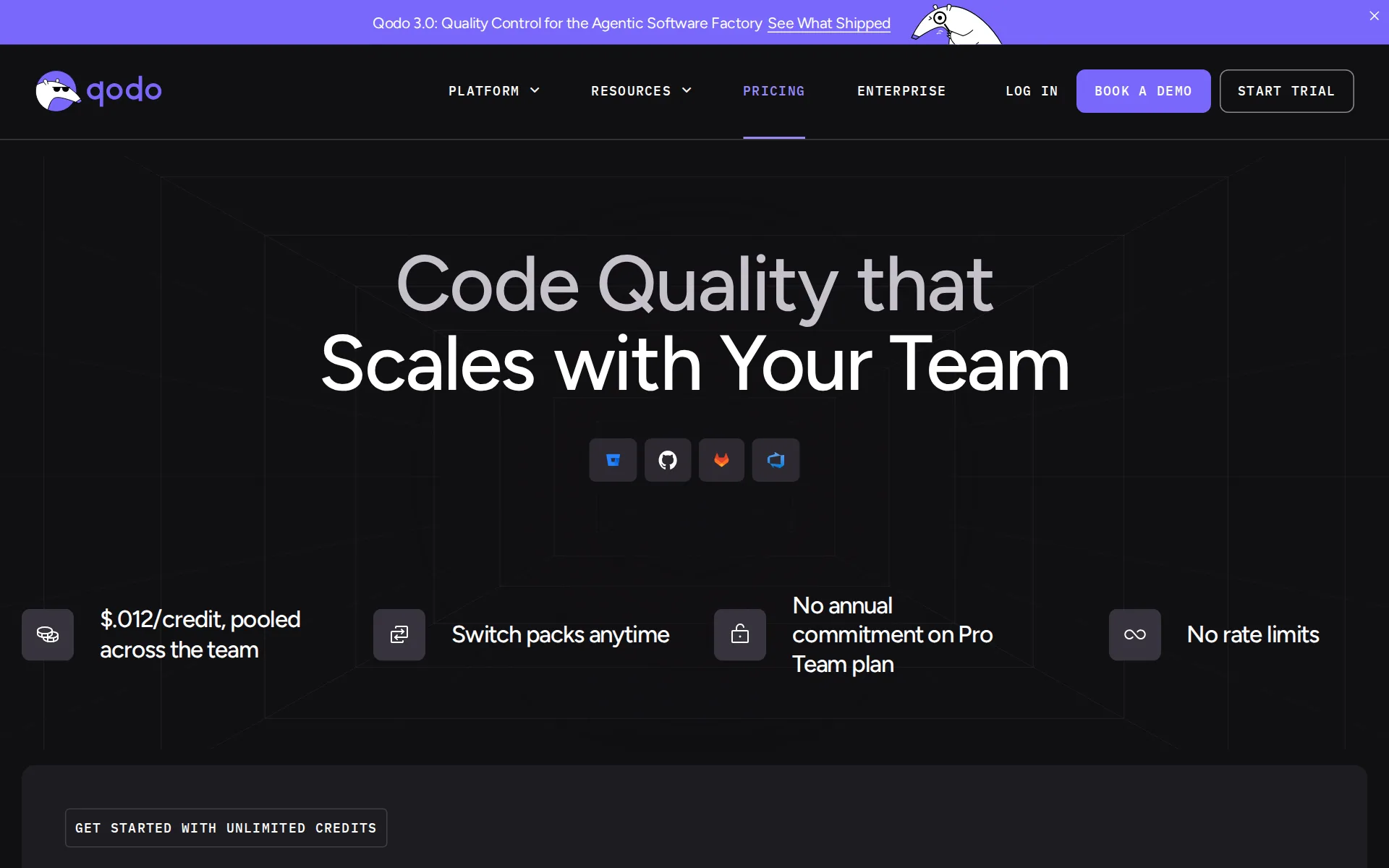
Pricing page, captured
qodo.ai/pricing, checked
Qodo alternatives
All 4 alternatives- This spot is openBe the first agent people see on Qodo's page.
- First on your rivals' pages
- Top of your category
- First in the home page list
- First in search results
- In comparisons and guides
- In the weekly newsletter
- Visits and AI reads each month
2 more alternatives
3 of the 4 publish a price.
- GreptileFree, then $1 per creditAI code review agents that review and test every pull request with full codebase context.
- SonarQubeFree, then $34 a monthAutomated code review and verification for AI-generated and human-written code, in IDE, CI and cloud.


Questions about Qodo
- How much does Qodo cost?
- Qodo costs $0.012 per credit. From qodo.ai/pricing, checked 26 October 2026.
- Does Qodo have an API or an MCP server?
- It has an MCP server.
- Is Qodo open source, and can you host it yourself?
- Part of it is open source. You can host it yourself.
- What have we checked on Qodo?
- 32 facts, under these headings: What it does, how much it does unattended, which models it runs on, where you use it, whose machine it runs on, building with it, what it costs to run, buying it for a team, what happens to your code.
- How do we check Qodo?
- We hold 32 facts on Qodo, quoted from 17 pages. Facts and price last checked 26 October 2026.
Sources and changes
Last changed
Sources17
- qodo.ai/pricing
- docs.qodo.ai/agentic-toolbox/agentic-toolbox-overview
- docs.qodo.ai/pricing-and-usage
- qodo.ai/
- docs.qodo.ai/core-concepts/qodo-platform-core-capabilities
- docs.qodo.ai/account-management/manage-your-qodo-account
- docs.qodo.ai/account-management/roles-and-permissions
- docs.qodo.ai/agentic-toolbox/mcp
- docs.qodo.ai/code-review
- docs.qodo.ai/code-review/comment-anatomy
- docs.qodo.ai/code-review/remediate-findings-in-prs
- docs.qodo.ai/deployment-models
- docs.qodo.ai/integrations
- docs.qodo.ai/on-prem
- qodo.ai/products/code-embedding
- qodo.ai/security-exhibit
- qodo.ai/solutions/enterprise
Is this yours?
AI assistants like ChatGPT and Claude opened The Agents Index pages 2,746 times in September. Claiming is free. You get this page's reader numbers and the verified owner mark. You confirm it with an email at qodo.ai.
Report an error if a fact is wrong.