Summary
Google's Agent Development Kit is a framework for building agents and multi-agent systems, published as libraries for Python, TypeScript, Go, Java and Kotlin. It bundles the runtime, a local developer UI, an evaluation harness and deployment commands that carry an agent from script to production.
- Best for
- Teams that want Google's own official, actively-developed agent SDK, especially polyglot teams (Python/Go/Java/TypeScript/Kotlin) or anyone building multi-agent systems that need to interoperate across vendors via the A2A protocol.
- Not for
- Teams with no Google Cloud/Gemini affinity who want the single largest third-party integration ecosystem and the longest production track record. LangChain still carries more years of battle-testing and a much larger community today.
- From
- Free
- Free tier
- YesThe framework itself is free and open source under Apache 2.0, installed from package managers with no account, no seats and no usage metering by Google. Costs arrive only from the model provider whose API key you supply and, if you deploy there, from Google Cloud: the vendor notes Agent Runtime is a paid service with a no-cost access tier above which you incur costs.
What it does
- Writes code
- PartlyADK does not write application code for you, but its Visual Builder inside the local web UI generates agent projects from a graphical design with an AI assistant, and the vendor marks that builder experimental and Python-only.
The Visual Builder allows you to design, build, and test agents in a beginner-friendly graphical interface, and includes an AI-powered assistant to…
adk.dev/visual-builder - Debugs and fixes
- PartlyThe bundled web UI and event/trace inspection let a developer diagnose why an agent failed, but landing the code fix is left to the developer or to a separate AI coding tool; ADK ships no repair agent.
The ADK web interface lets you test your agents directly in the browser. This tool provides a simple way to interactively develop and debug your…
adk.dev/runtime/web-interface - Writes tests
- PartlyWhat it generates are agent evaluation sets captured from real sessions, not unit tests; the evaluation tooling is documented as Python-only, so other language bindings do not get it.
Creating evalsets manually can be complex, therefore UI tools are provided to help capture relevant sessions and easily convert them into evals…
adk.dev/evaluate - Reviews code
- PartlyReview is not a built-in behaviour: you assemble an agent with the documented GitHub MCP toolset and your own access token, and the vendor frames reviewing changes as something the AI can help with.
Issue & PR Automation: Create, update, and manage issues and pull requests. Let AI help triage bugs, review code changes, and maintain project boards.
adk.dev/integrations/github - Whole-codebase work
- PartlyThe documented route across an existing repository is Agents CLI skills driving your own coding agent through an incremental migration; ADK itself carries no repository-wide refactor engine.
Instead of manually rewriting state objects, node graphs, and execution loops line by line, you can use Agents CLI to plan and execute the migration…
adk.dev/get-started/migrate - Ships it
- YesDeployment is part of the framework: one command pushes an agent to Google Cloud, and the same agent can be containerised and run on infrastructure you control instead.
You can containerize and run ADK on your own infrastructure, or take advantage of our native, one-command deployment to Google Cloud.
adk.dev - Done-for-you service
- NoNobody builds or runs the agent for you: this is a library you install and operate yourself, and the site's 235-page sitemap carries no services, retainer or consulting offer.
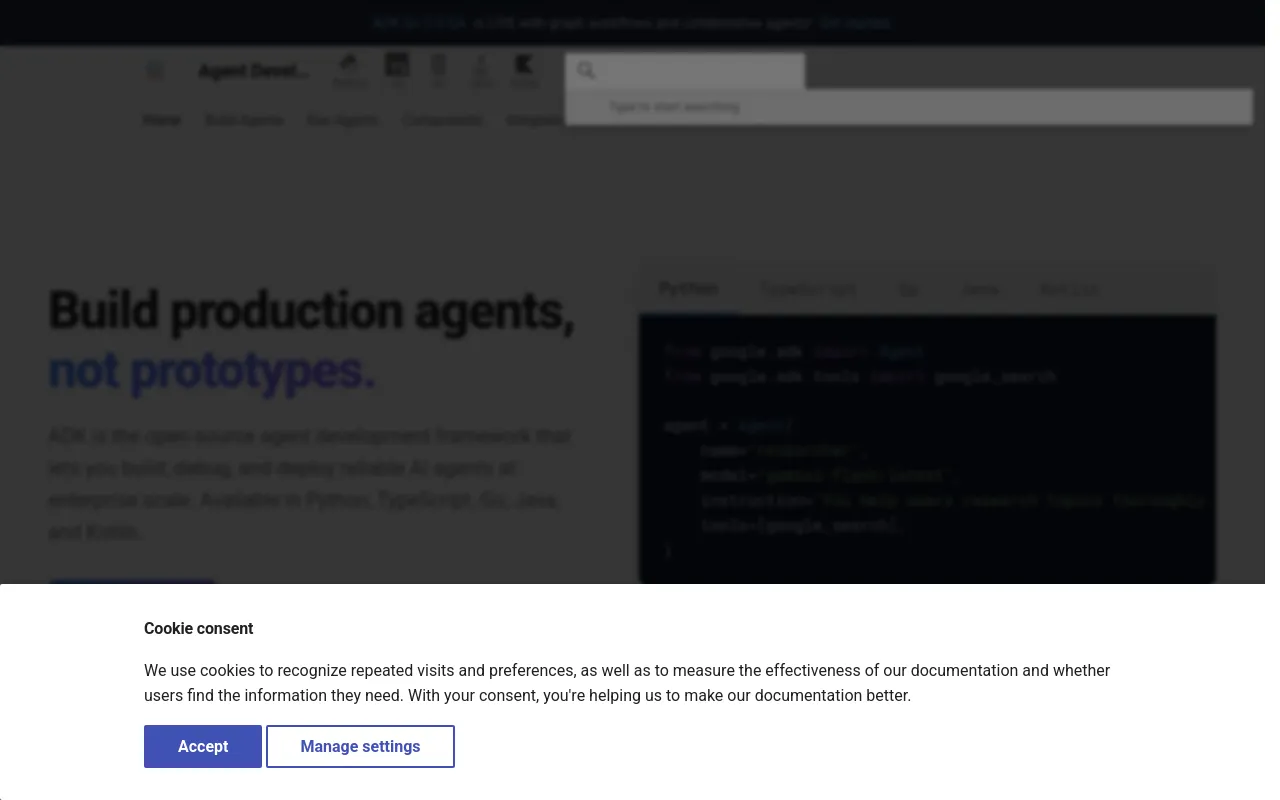
ADK is the open-source agent development framework that lets you build, debug, and deploy reliable AI agents at enterprise scale.
adk.dev
How much it does unattended
- Runs autonomously
- YesAgents can be triggered by events, queues or a schedule and run as background processes with no person in the loop, which the vendor documents as ambient agents.
These agents can run as background processes to process data, monitor events, and respond asynchronously without human intervention.
adk.dev/runtime/ambient-agents - Multi-agent
- YesMulti-agent composition is the headline design: hierarchies of specialised agents that delegate sub-tasks, plus sequential, parallel and loop workflow agents for deterministic orchestration.
Multi-Agent System Design: Easily build applications composed of multiple, specialized agents arranged hierarchically.
adk.dev/get-started/about - Agent permissions
- YesAutonomy is set per tool by the developer: a tool can be configured to pause and ask a human or a supervising system before it runs, though the vendor labels this confirmation feature experimental.
The Tool Confirmation feature in the Agent Development Kit (ADK) allows an ADK Tool to pause its execution and interact with a user or other system…
adk.dev/tools-custom/confirmation
Which models it runs on
- Claude
- YesClaude is supported in Python and Java, either through the registry wrapper on Google Cloud Agent Platform or directly against Anthropic with your own API key.
You can use Anthropic's Claude models with ADK in both Python and Java. Choose the path that matches your language and backend below.
adk.dev/agents/models/anthropic - GPT
- YesOpenAI models reach ADK two ways: a native Go package the vendor marks experimental, and the LiteLLM connector for Python, so the path depends on your language.
You can use OpenAI models with ADK. How you connect depends on the language
adk.dev/agents/models/openai - Open models
- YesOpen-weight models run through LiteLLM against local hosts such as Ollama, with separate documented paths for vLLM and on-device LiteRT-LM serving.
Ollama is a tool that allows you to host and run open-source models locally. ADK integrates with Ollama-hosted models through the LiteLLM model…
adk.dev/agents/models/ollama - Model choice
- YesYou choose the model per agent, including a router that picks between several at runtime; Gemini is the default path but not a requirement of the framework.
Agent Development Kit (ADK) is designed for flexibility, allowing you to integrate various Large Language Models (LLMs) into your agents.
adk.dev/agents/models
Where you use it
- In your editor
- PartlyThere is no ADK editor extension; instead Agents CLI installs ADK skills into existing AI coding environments, and a docs MCP server can be added to the same tools.
The Agents CLI tool set lets you plug ADK agent expertise into your favorite AI-coding environments including Antigravity, Claude Code, Cursor, and…
adk.dev/tutorials/coding-with-ai - On the command line
- YesA terminal surface is first-class: an interactive run command with session save, resume and replay flags in the Python CLI, and an embedded launcher for Go binaries.
ADK provides an interactive terminal interface for testing your agents. This is useful for quick testing, scripted interactions, and CI/CD pipelines.
adk.dev/runtime/command-line - In your pipeline
- PartlyThe CLI is documented for scripted and CI/CD use and evaluations run headless, but nothing on the site describes ADK acting on a pull request by itself without an agent you build.
ADK provides an interactive terminal interface for testing your agents. This is useful for quick testing, scripted interactions, and CI/CD pipelines.
adk.dev/runtime/command-line - In a browser
- PartlyThe browser UI exists but you run it locally and the vendor bars it from production, so there is no hosted web application unless you deploy your own agent service.
ADK Web is not meant for use in production deployments. You should use ADK Web for development and debugging purposes only.
adk.dev/runtime/web-interface
Whose machine it runs on
- Self-hosted
- YesSelf-hosting is a documented first-class path: package the agent as a container and run it anywhere, including locally in Docker or Podman with no Google Cloud connection.
You can manually package your Agent into a container image and then run it in any environment that supports container images. For example you can run…
adk.dev/deploy - Open source
- YesThe framework is published as open source under Apache 2.0 with language bindings distributed through the usual package managers, and the docs invite outside contributions.
By contributing, you agree that your contributions will be licensed under the project's Apache 2.0 License.
adk.dev/community/contributing-guide
What it costs to run
- How it meters
- PartlyThe framework meters nothing. You pay the model provider whose key you supply, plus Google Cloud's Agent Runtime beyond its no-cost tier if you deploy there.
Agent Runtime is a paid service and you may incur costs if you go above the no-cost access tier.
adk.dev/deploy/agent-runtime - Free tier
- YesYou install it from a package manager and run it without an account, a sales call or a card; the site publishes no pricing page at all for the framework.
ADK is the open-source agent development framework that lets you build, debug, and deploy reliable AI agents at enterprise scale.
adk.dev - API access
- YesA built-in server exposes your agents over REST for programmatic calls, and the same launcher serves the API alongside the web UI in the compiled languages.
Use the API server in ADK to expose your agents through a REST API for programmatic testing and integration.
adk.dev/runtime/api-server - MCP server
- YesMCP works in both directions: agents consume external MCP servers as tools, and you can wrap ADK tools in an MCP server that any other MCP client can call.
Exposing ADK Tools via an MCP Server: How to build an MCP server that wraps ADK tools, making them accessible to any MCP client.
adk.dev/mcp - Bring your own key
- YesInference always runs on your own credentials: the quickstart has you write your own model API key into a local env file, and the runtime is yours to host.
This project uses the Gemini API, which requires an API key. If you don't already have Gemini API key, create a key in Google AI Studio on the API…
adk.dev/get-started/python
Buying it for a team
- Admin controls
- PartlyConstraints exist but they are code, not a console: a plugin registered once on the runner applies its checks globally to every agent, tool and model call, and a developer must write it.
Policy enforcement: Implement security guardrails, such as a function that checks if users are authorized to use a specific tool and prevent its…
adk.dev/plugins - Audit log
- PartlyExecution is recorded in depth through built-in logging, metrics and traces, but this is telemetry about agent runs on infrastructure you own, not an administrative audit trail of who changed what.
Agent Development Kit (ADK) provides built-in observability through logging, metrics, and traces to help you monitor and debug your agents.
adk.dev/observability
What happens to your code
- Opt out of training
- PartlyADK's own usage telemetry is off until you switch it on and explicitly excludes source files, prompts and credentials, but the site says nothing about what the model provider you route to may do with your data.
Data collection is OFF by default until you explicitly choose to enable it.
adk.dev/runtime/command-line - Data residency
- YesJurisdiction is whatever you choose, because you host the container: the vendor documents running it disconnected from Google Cloud entirely, and cloud deploys take an explicit region.
This is a good option if you prefer to run offline or disconnected, or otherwise in a system that has no connection to Google Cloud.
adk.dev/deploy - Getting out
- YesConversation data is yours on disk: sessions save to a plain JSON file and can be pointed at your own database or storage service, and no credits exist to expire.
You'll be prompted to enter a session ID, and the session will be saved to path/to/my_agent/<session_id>.session.json.
adk.dev/runtime/command-line
Not established: Certifications
30 sourced claims on this page. Checked 2026-09-15. How we check.
Alternatives
Where we would send a reader instead, in that listing's own words.
Open-source SDK for AI agents and multi-agent workflows across .NET, Python and Go.
Open source agent frameworks plus LangSmith, the platform for tracing, evaluating and deploying agents.
Open-source Python framework for building agents with tools, handoffs, guardrails, sandboxes and tracing.
Python and TypeScript library that runs Claude Code's agent loop and tools inside your own application.
Filed under
Sources and updates
The pages we read33
1 of 33 independent of the vendor.
- adk.dev/8 fields
- adk.dev/get-started/agents-cli4 fields
- adk.dev/runtime/command-line4 fields
- adk.dev/deploy3 fields
- adk.dev/get-started/about3 fields
- adk.dev/runtime/web-interface3 fields
- adk.dev/agents/models/litellm2 fields
- adk.dev/agents/models/openai2 fields
- adk.dev/deploy/cloud-run2 fields
- adk.dev/evaluate2 fields
- adk.dev/integrations/github2 fields
- adk.dev/tutorials/coding-with-ai2 fields
- adk.dev/agents/models1 field
- adk.dev/agents/models/anthropic1 field
- adk.dev/agents/models/ollama1 field
- adk.dev/community/contributing-guide1 field
- adk.dev/deploy/agent-runtime1 field
- adk.dev/get-started/installation1 field
- adk.dev/get-started/migrate1 field
- adk.dev/get-started/python1 field
- adk.dev/integrations/gitlab1 field
- adk.dev/mcp1 field
- adk.dev/observability1 field
- adk.dev/observability/logging1 field
- adk.dev/plugins1 field
- api.github.com/repos/google/adk-pythonPlatform record1 field
- adk.dev/runtime/ambient-agents1 field
- adk.dev/runtime/api-server1 field
- adk.dev/safety1 field
- adk.dev/sessions1 field
- adk.dev/tools-custom/confirmation1 field
- adk.dev/visual-builder1 field
- adk.dev/workflows/collaboration1 field
Platform record2026-08-30
- Licence
- Apache-2.0
- Stars
- 21,331
- Forks
- 3,912
- Last push
- 2026-08-30
Coverage elsewhere6
Updates5
- Capabilities · Commercial terms · Free tier · Price
- Capabilities · Commercial terms · Free tier
- Capabilities · Commercial terms · Free tier
- Alternatives · Documentation link · One-liner · Repository · Summary
- Summary